
The Computer Room
How frictionless input prevents us from actually creating anything

Everyone seems to agree that the solution to digital overload is to go offline. Log off, girl. Disappear for a while. Touch grass. While well-intentioned, this advice misunderstands the problem. The problem isn’t that the internet exists, or that we spend too much time on it. It’s that we’ve allowed one system to absorb too many roles at once. The internet has become where we discover ideas, maintain relationships, do our work, avoid boredom, seek validation - all in one sitting. Everything blurs together and nothing really lands.
The ‘Computer Room’
The internet used to live somewhere.
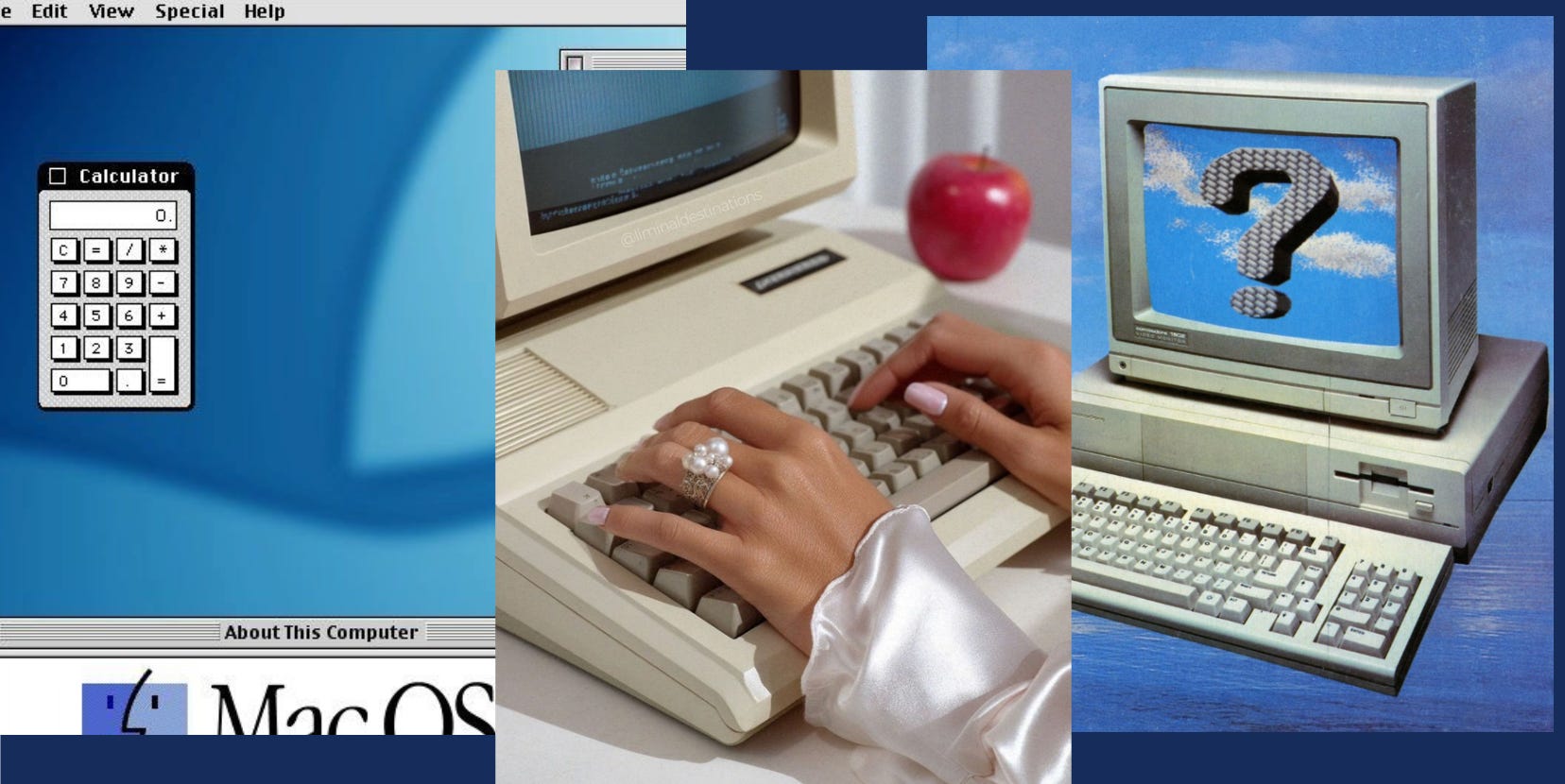
In our house, we had the Computer Room. Essentially my mom’s desk with an Apple Macintosh computer. ‘Going online’ meant physically going to that room and sitting down in the office chair. It also meant taking turns. Having an older sister built in a timer whether claimed or implied. I knew when my time was up because someone else needed the computer - unless we were both hunched over it playing NeoPets together.
On my turn, I’d check my email (though I still don’t know how many times a 9-year-old really needs to check their inbox). The messages I was getting were from my grandparents, or chain emails warning that if I didn’t forward them to ten people, something bad would happen.
When you stood up and left the room, the online world stayed behind. It didn’t follow you to the kitchen. It didn’t sit in your pocket. It didn’t fill every empty moment. You were just bored, and it never occurred to you to return to the Computer Room to fill that void.
The Expansion Problem
The internet didn’t become this beast overnight. It expanded slowly and then all at once until it became the place where everything happened. The same system now handled discovery, communication, work, entertainment, validation, boredom, even rest. Things that once lived in different physical spaces and mental places now share the same surface. A message notification interrupts a thought. Inspiration sits directly alongside distraction. There’s no transition time anymore, no sense of context shifting. Everything competes simultaneously for attention.
This is perhaps where the modern version of that scary chain email shows up. It doesn’t threaten you with bad luck if you ignore it. It just suggests you’ll miss out. Save this. Screenshot that. You’ll want this later. The pressure is less explicit now, but it’s constant.
We’re overstimulated, yes, but we’re also disoriented. We’ve been swept off our feet by the web - by how quickly it expanded, how much it could do. Its role kept growing, and we never paused to define its boundaries. We need to ground ourselves again. That doesn’t require going offline and touching grass. It just requires us to be clear about why we’re here in the first place.
It’s interesting to look at early articles on the web (NYT has an incredible archive) because this wasn’t entirely a surprise. As early as 1995, the belief was that the internet might “deliver us community with a vengeance — and we may find we don’t want it.”
What the Internet is Great At
For all its excesses, the internet is still very good at one thing in particular: discovery. It exposes us to ideas we wouldn’t otherwise encounter. People we wouldn’t meet. References we didn’t know to look for. We can learn something new in minutes, follow a thread of curiosity into a deep rabbit hole and stumble onto work that changes how we see our own.
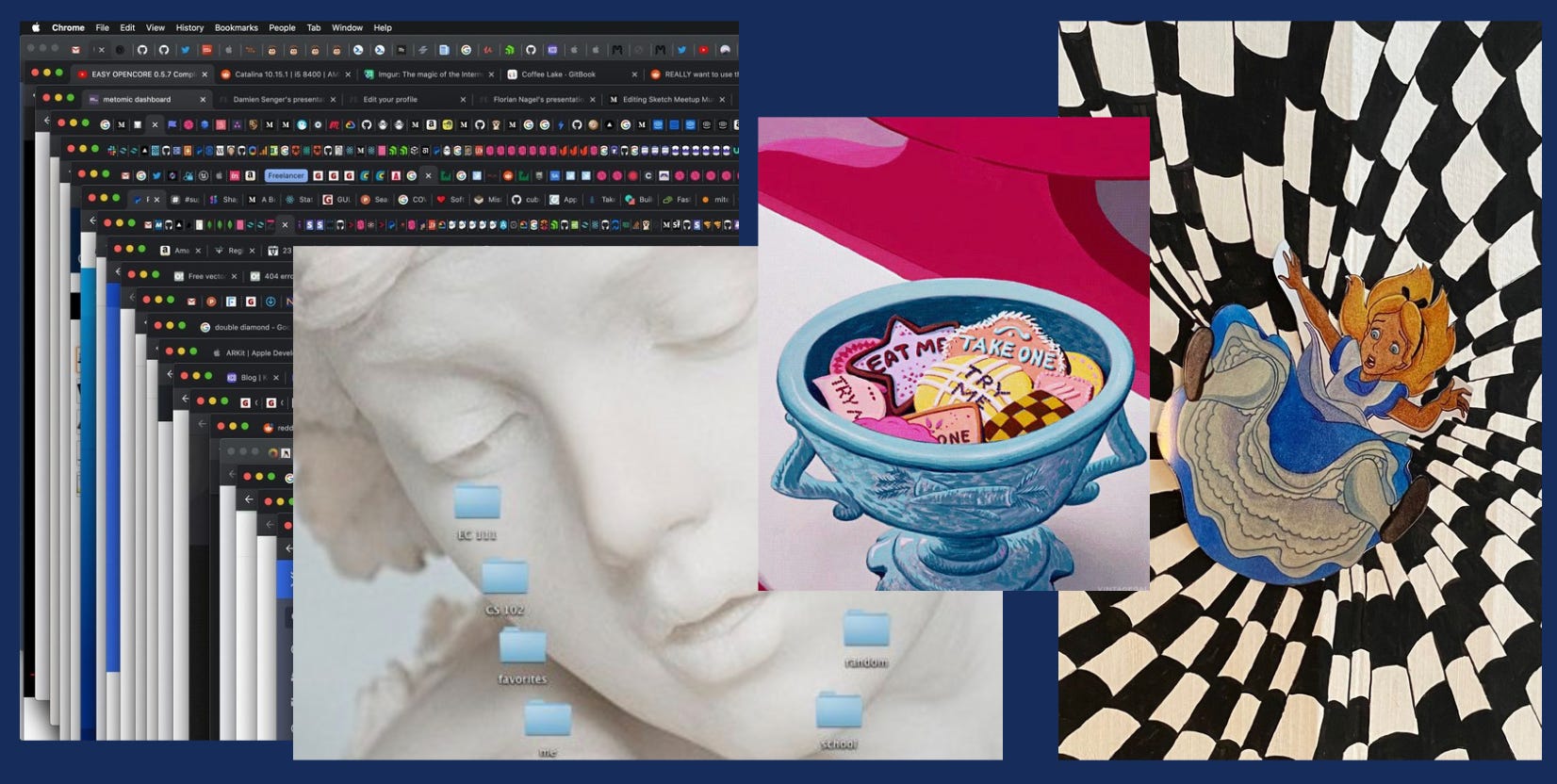
The problem was never curiosity. If anything, we’re more curious than ever - about how other people live, what they make, how things work, what’s out there. What’s changed is what happens after that initial exploratory phase. So much of what we find online is designed to stay in circulation rather than move somewhere else. We bookmark articles we never actually get to reading. Save recipes we'll get to at some point. Screenshot ideas we swear we’ll come back to, then keep scrolling. The internet excels at generating input, but is not one bit concerned with what that input becomes.
Isn’t the point of discovery is that it becomes the beginning of something? A song you’ve never heard before that broadens your taste in music. A city you visit reshapes how you imagine living. An idea about work-life balance that reorders your priorities. So many of the things that have moved culture forward began with exposure, not necessarily with clear intention. ‘Stumbling upon’ something used to felt kismet. Like you were meant to find that thing, and it was meant to leave its mark. Discovery is only really worthwhile when it goes somewhere - when what we find online changes how we think, choose and act. At its most romantic, discovery alters your trajectory.
The Input-Output Gap
But for all that possibility, so much of what we discover never really gets the chance to change us. We take things in faster than we can metabolise them. Articles, references, ideas, recommendations - input has become entirely frictionless. We no longer need to go to the library, the museum, or even the Computer Room. Meanwhile, output still asks for time, space and commitment.
So much of what we encounter could alter our trajectory if it met us with enough space to land. The problem isnt our lack of receptiveness - it’s the interruption. One thought or idea is quickly followed by another, suddenly different in tone or topic.
When discovery doesn’t lead anywhere, it loses its potential for expansion. It passes through us without leaving much behind. And over time, that changes how we relate not just to the internet, but to our own ideas. How seriously we take them, how far we’re willing to follow the threads of our curiosity.
One Job at a Time
The Computer Room worked because it was specific and imposed limits. We don’t have that built-in room anymore*, but maybe we can still apply the principle. What if we gave the internet one job at a time? Some people are building this kind of specificity already. Substack in the morning with a fresh coffee. Pinterest opened to find visual references for a project, then closed. Phone left out of the bedroom (!)
This isn’t about going offline. It’s about giving the internet clearer moments and clearer limits, so what we find there has a chance to take shape in our lives. Let’s bring back the Computer Room. Now as a practice.
*if you actually do have a computer room I would like to know.
__
Thank you for reading! I will be launching Quiet Media, a print zine, in early 2026 that explores how our attention is shaped by the systems around us - and what becomes possible when we choose to design for depth. Enter your email below to be kept up to date on the launch.
Ooof so true about what happens after finding something we're curious about. And with the amount we take in, even if we did do something with it how could we even hope to metabolise everything?! My brain is tired 😅
I have a computer room! (Well it is also where the laundry hangs to dry) But my computer is there, also my tablet stays in this room. I also try to leave my phone in that room as best as I can (and it is never ever allowed in the bedroom)
Most of my friends think I‘m too strict, but I need to protect my mental health and that’s the only way for me to not constantly look on my devices.